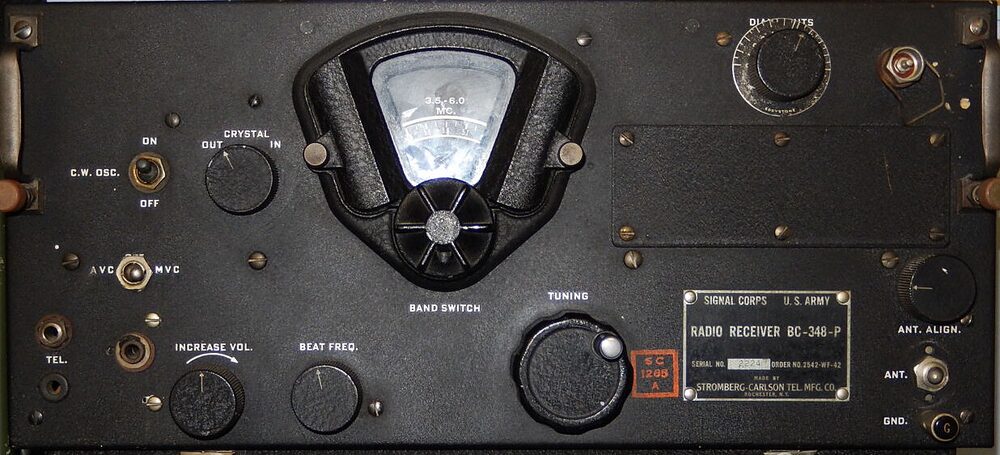
The BC-348 is one of the best-known military valve receivers of the Second World War. Designed for the US Army Air Forces, it was used in American bombers and transport aircraft, including the B-17 Flying Fortress, B-24 Liberator and B-29 Superfortress.
It is a particularly interesting receiver because it combined a comprehensive shortwave frequency range with a compact, self-contained design intended for airborne operation. It also became a favourite with radio amateurs after the war when thousands entered the surplus market.
The BC-348 was primarily intended as the long-distance communications receiver in aircraft. Its job was to receive communications between aircraft and ground stations, as well as messages from other aircraft.
It was commonly paired with transmitters such as:
- BC-375: an earlier aircraft transmitter.
- AN/ART-13: a later and very capable aircraft transmitter.
Together, the receiver and transmitter provided the aircraft with long-distance radio communications. The receiver was introduced before the USA entered WWII and was manufactured in very large numbers during the war. More than 100,000 were produced.
Frequency coverage
One of the impressive features of the BC-348 was its wide frequency coverage.
Depending on the model, it covered:
| Band | Frequency |
|---|---|
| 1 | 200–500 kHz |
| 2 | 1.5–3.5 MHz |
| 3 | 3.5–6.0 MHz |
| 4 | 6.0–9.5 MHz |
| 5 | 9.5–13.5 MHz |
| 6 | 13.5–18.0 MHz |
This coverage allowed operators to listen to longwave, medium-frequency and shortwave communications, including international and military traffic.
The BC-348 is an eight-valve, single-conversion superheterodyne receiver. Its main features include:
- Two stages of RF amplification.
- Three intermediate-frequency amplification stages.
- Intermediate frequency of 915 kHz.
- Beat Frequency Oscillator (BFO) for CW and Morse reception.
- Crystal filter for improved selectivity.
- Automatic Volume Control (AVC).
- Manual Volume Control (MVC).
The crystal filter was particularly useful when trying to separate closely spaced Morse signals. The BFO allowed the operator to hear Morse transmissions as an audible tone rather than simply hearing an unmodulated carrier.
The power supply
One interesting aspect of the BC-348 is its power supply. Aircraft electrical systems of the period generally supplied 28 volts DC. However, the receiver's valves needed a much higher voltage for their anodes. The solution was a built-in dynamotor.
A dynamotor is essentially a motor and generator combined in one machine. The 28-volt aircraft supply drove the motor, which in turn generated the high voltage required by the receiver.
It was a clever solution for aircraft equipment, avoiding the need for a separate mains power supply. The related BC-224 receiver was designed for 14-volt aircraft electrical systems.
Different versions of the BC-348
There were numerous production versions, identified by a letter suffix.
Some of the manufacturers included:
- RCA
- Wells-Gardner
- Belmont Radio
- Stromberg-Carlson
Examples include the BC-348-J, BC-348-N, BC-348-Q and BC-348-R.
Although the general design remained similar, there were differences in circuitry, components, front-panel arrangements and frequency coverage. The front panel was designed with the aircraft radio operator in mind.
The principal controls included:
- Tuning: Selects the desired frequency.
- Band switch: Selects the operating frequency range.
- Volume control: Controls receiver output.
- AVC/MVC: Selects automatic or manual volume control.
- BFO: Provides the beat-frequency oscillator for CW reception.
- Crystal filter: Helps improve selectivity.
- Antenna adjustment: Allows the aerial input circuits to be aligned.
The receiver was designed to be operated locally, rather than remotely controlled.