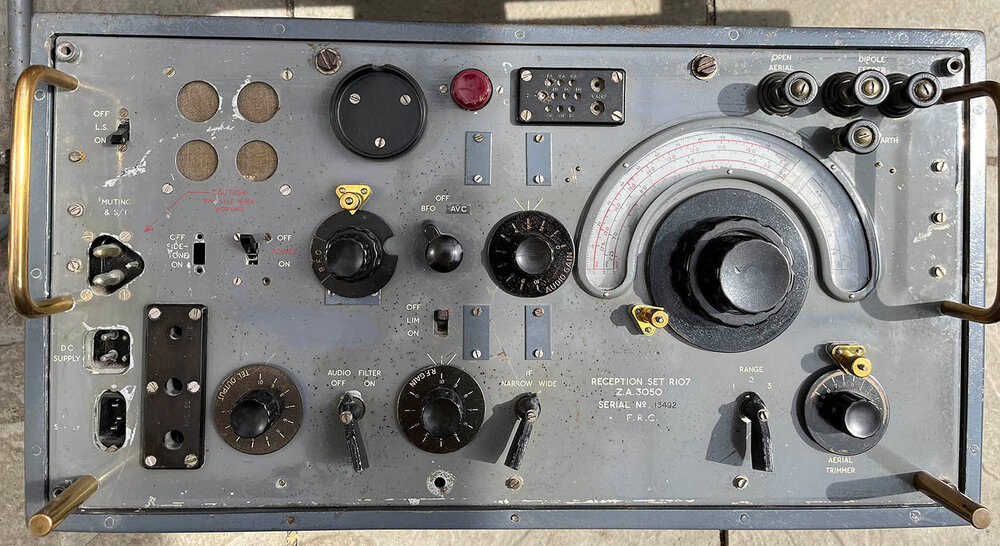
 The Reception Set R.107 was a British Army short-wave communications receiver developed during the Second World War. It was designed as a robust, high-performance receiver for military wireless communications and was particularly associated with the British Wireless Sets No. 12 and No. 33.
It was a substantial piece of equipment, built for field and military station use, and capable of receiving both Morse (CW) and voice transmissions. The steel cabinet was, allegedly, bullet proof! The receiver I had was built like a tank and weighed almost as much!
Technical specifications
| Specification | Details |
|---|---|
| Designation | Reception Set R.107 |
| Period | Around 1940–1941 onwards |
| Type | Superheterodyne receiver |
| Valve count | 9 valves (8 receiver valves plus rectifier) |
| Frequency coverage | 1.2–17.5 MHz |
| Frequency bands | 3 ranges |
| Intermediate frequency | 465 kHz |
| Reception modes | CW and R/T (voice) |
| Bandwidth | Wide and narrow |
| Power | 100–250 V AC or 12 V accumulator |
| Weight | Approximately 48.5 kg (106 lb) |
The R.107 was a nine-valve superheterodyne receiver with RF amplification ahead of the mixer, giving it good sensitivity and performance for its era.
What made the R.107 special?
The R.107 was considered a high-grade general-purpose military receiver rather than simply a basic field radio. It was used in ground stations and vehicle installations, often alongside transmitters such as the WS.12 and WS.33. It could also be used independently as a monitoring or communications receiver. Here is my page on the Wireless Set No. 12.
Its main features included:
- Three tuned RF circuits: providing useful preselection ahead of the IF stages.
- Two IF amplifier stages: operating at 465 kHz.
- BFO (Beat Frequency Oscillator): allowing Morse code reception.
- AVC (Automatic Volume Control): useful for voice reception and handling varying signal strengths.
- Selectable IF bandwidth: approximately 3 kHz narrow and 7.5 kHz wide.
- Audio filter: particularly useful for improving Morse reception.
- Crash limiter: designed to reduce the annoyance of sudden static crashes.
- Built-in loudspeaker: making it a self-contained station receiver.
- Headphone and line outputs: for alternative listening arrangements.
The receiver was designed with practical military servicing in mind, and its circuits were arranged across separate chassis sections, making the internal construction relatively logical for maintenance.
Valve line up
The receiver used a surprisingly small variety of valves, which was helpful in military service where keeping spare components was important.
| Valve | Function |
|---|---|
| 4 × ARP34 (EF39 equivalent) | RF and IF amplification |
| 4 × AR21 (EBC33 equivalent) | Frequency conversion, detection, audio and BFO functions |
| 1 × 6X5G | Power supply rectifier |
The design was a single-conversion superheterodyne with a 465 kHz intermediate frequency.
Versions and construction
There were different production versions of the R.107. Early receivers were associated with the designation ZA 3220, while later examples carried other military stores numbers, including ZA 25266.
Differences can be seen in tuning dial design, wiring materials and some internal construction details. A tropicalised version, identified by the suffix R.107T, was also produced.
The receiver was built into a substantial metal cabinet, with a protective cover arrangement for the front panel. Its weight and rugged construction made it a true military communications receiver rather than a portable domestic radio.