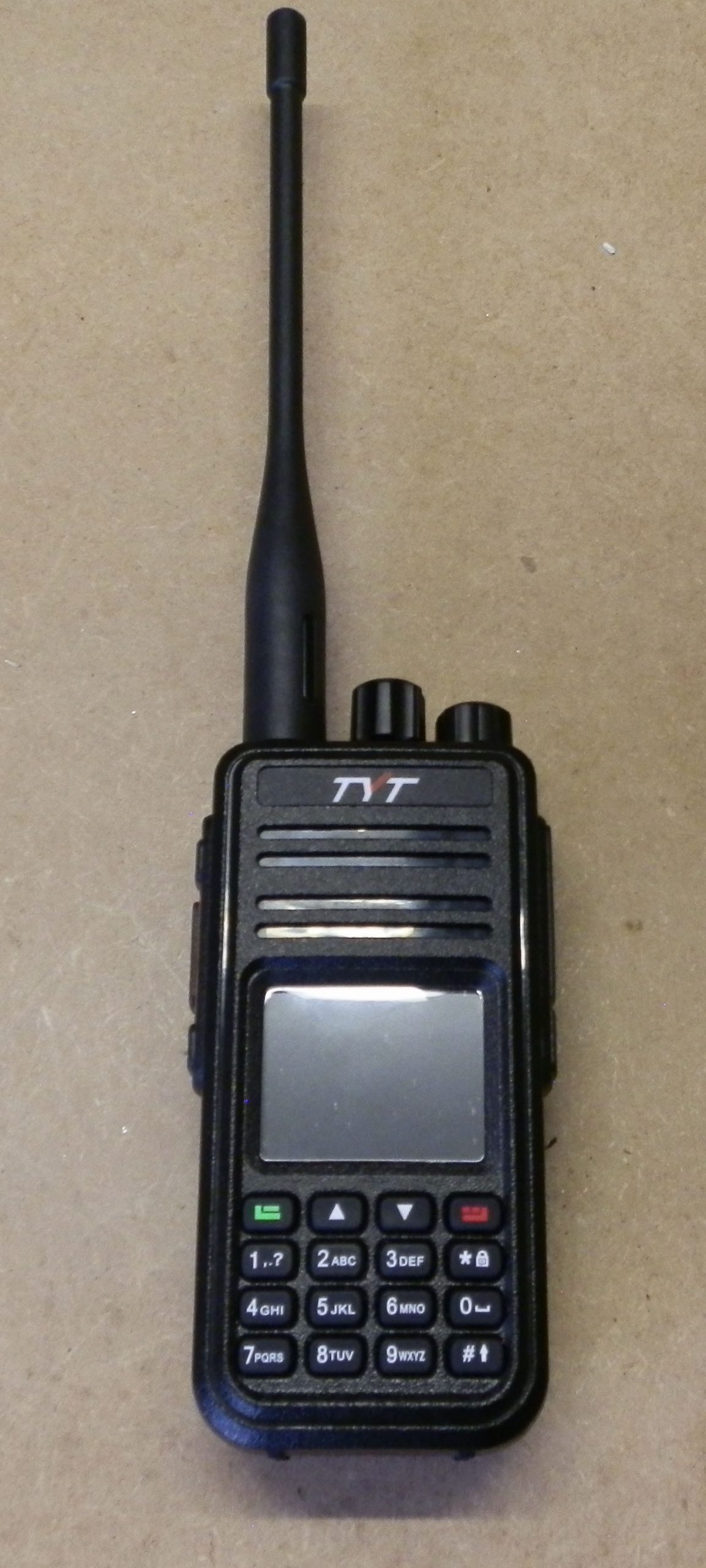
 I’m now the proud owner of a TYT MD UV380 DMR FM handheld. It covers 70cms and 2 metres as well as VHF marine frequencies and PMR 446. This is a professional rather than amateur radio so the programming is somewhat complex... until you get used to it. You will need to download the programming software and a codeplug. To be honest, setting it up was beyond me so I enlisted the help of Roy, a genius with most things radio and computer related.
I’ve never been into digital comms and have no knowledge whatsoever of how it all works. But, I’ve now been on a couple of repeaters and chatted on Hubnet. I’ve been working mainly through our local repeater, GB7CQ – and making some procedural mistakes! Leaving up to 10 seconds before replying to a station takes some getting used to. And there’s no K on digital repeaters.
I do have one problem... I’ve run out of aerials! The radio could do with a dual band 2 metre 70cms aerial but, for now, it’s connected to a 10 ele 70cms beam. Unfortunately, I’m too far away from our 70cms digital repeater to employ the radio’s rubber duck aerial.
Main specifications
| Feature | Specification |
|---|---|
| VHF coverage | 136–174 MHz |
| UHF coverage | 400–480 MHz |
| Modes | Analogue FM and DMR |
| DMR standard | Tier II |
| Channels | Up to 3000 |
| Zones | Up to 250 |
| Display | Colour LCD |
| Power | Approximately 5 W VHF/UHF |
| Battery | Rechargeable Li-ion |
| Programming | USB programming cable |
The receiver
The TYT MD-UV380 uses a direct-conversion receiver, rather than a traditional superheterodyne receiver. This is an important distinction, particularly if you are interested in receiver design and RF engineering.
How does the receiver work?
The AT1846S chip is a highly integrated RF transceiver device. In simplified terms, the receiver:
- Receives the incoming VHF or UHF signal.
- Uses its internal frequency synthesiser and mixer circuitry to convert the received signal directly to baseband.
- Processes the resulting signal for analogue FM or digital DMR reception.
- Passes the demodulated information into the radio's digital processing circuitry.
There is no conventional intermediate-frequency (IF) chain as found in a traditional superheterodyne receiver.
Direct-conversion receivers have advantages:
- Fewer external components.
- Smaller circuit boards.
- Lower manufacturing costs.
- Good integration of analogue and digital functions.
However, there can be disadvantages:
- Susceptibility to strong nearby signals.
- Potential DC offset and local oscillator leakage issues.
- Image and unwanted-signal rejection characteristics differ from traditional superhets.
Instruction manual in my manuals and circuits library.