Here are a few photographs of vintage telegraph and telephone equipment. I’ll be adding more photos and information soon.
Victorian GPO ABC Telegraph
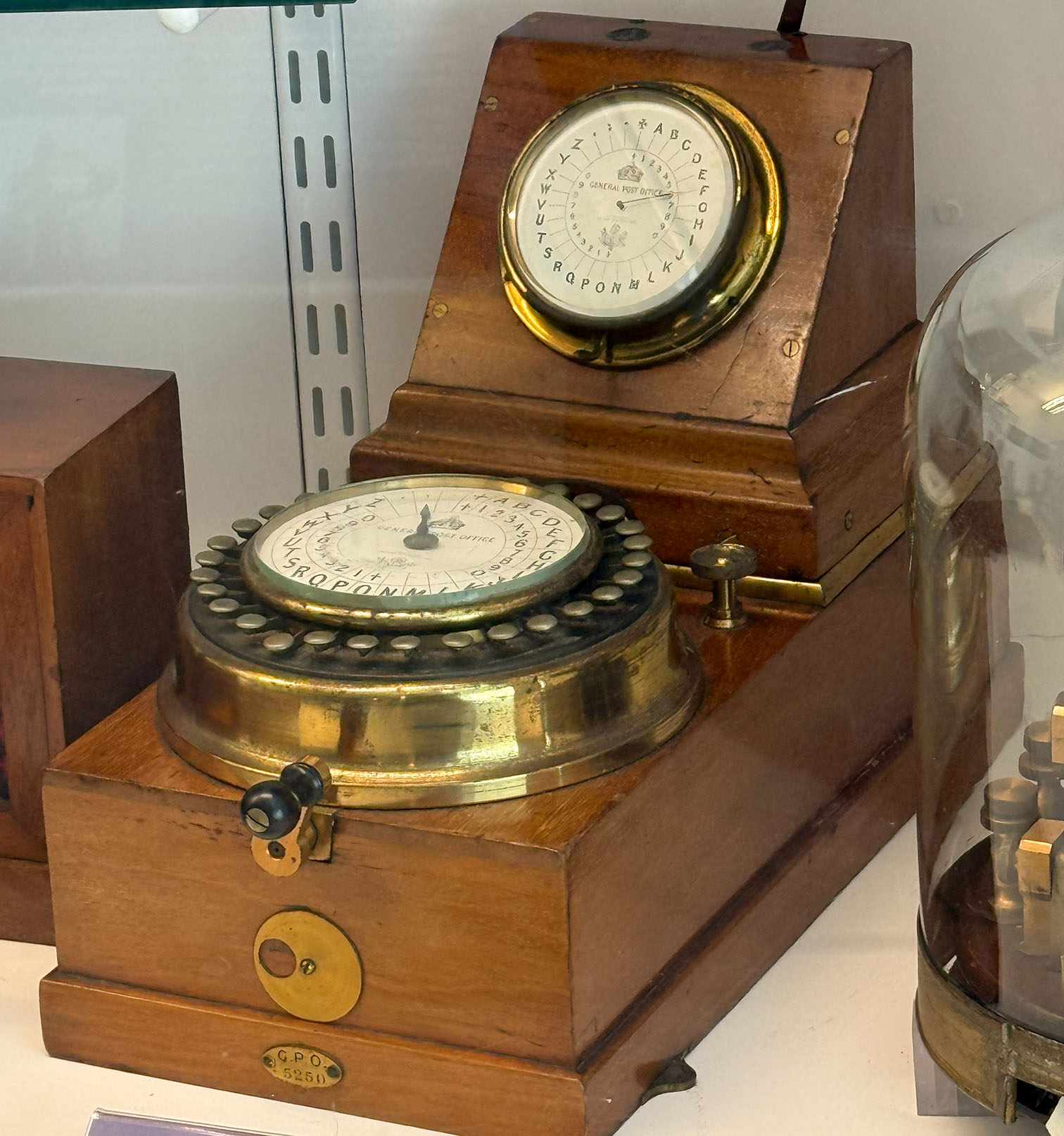 This is a Victorian GPO ABC Telegraph, also known as a Wheatstone alphabetical telegraph, used to send and receive messages electrically before the telephone became widespread. It is a particularly interesting example of early British telecommunications equipment.
The instrument is a combined telegraph transmitter and receiver, probably dating from the latter half of the 19th century, although the exact date requires further identification.
- Lower circular dial: The transmitting mechanism, with a ring of buttons corresponding to letters of the alphabet.
- Upper circular dial: The receiving indicator. Its pointer moved to the letter being transmitted from another station.
- Wooden cabinet: Houses the electrical and mechanical apparatus.
- Brass GPO plate: Identifies it as General Post Office equipment, with what appears to be the number 5250.
The operator pressed the button corresponding to the required letter and operated a hand-driven generator. Electrical impulses travelled along a telegraph wire, causing the pointer on the distant instrument to indicate the selected letter. Messages could therefore be sent without the operator needing to understand Morse code.
ABC telegraphs were employed in railway offices, businesses, newspaper offices, private telegraph networks and some fire brigade stations. The Post Office continued using some of these instruments well into the 20th century. A GPO historical account records one still operating on a North Wales circuit in 1930.
| The Instrument | |
|---|---|
| Type | Wheatstone ABC dial telegraph |
| Design | Charles Wheatstone |
| Period | Victorian, probably 1860–1880 |
| Organisation | British General Post Office |
| GPO plate | Appears to read 5250 |
| Construction | Wooden cabinet with brass transmitter and receiver |
Morse Telegraph Recorder
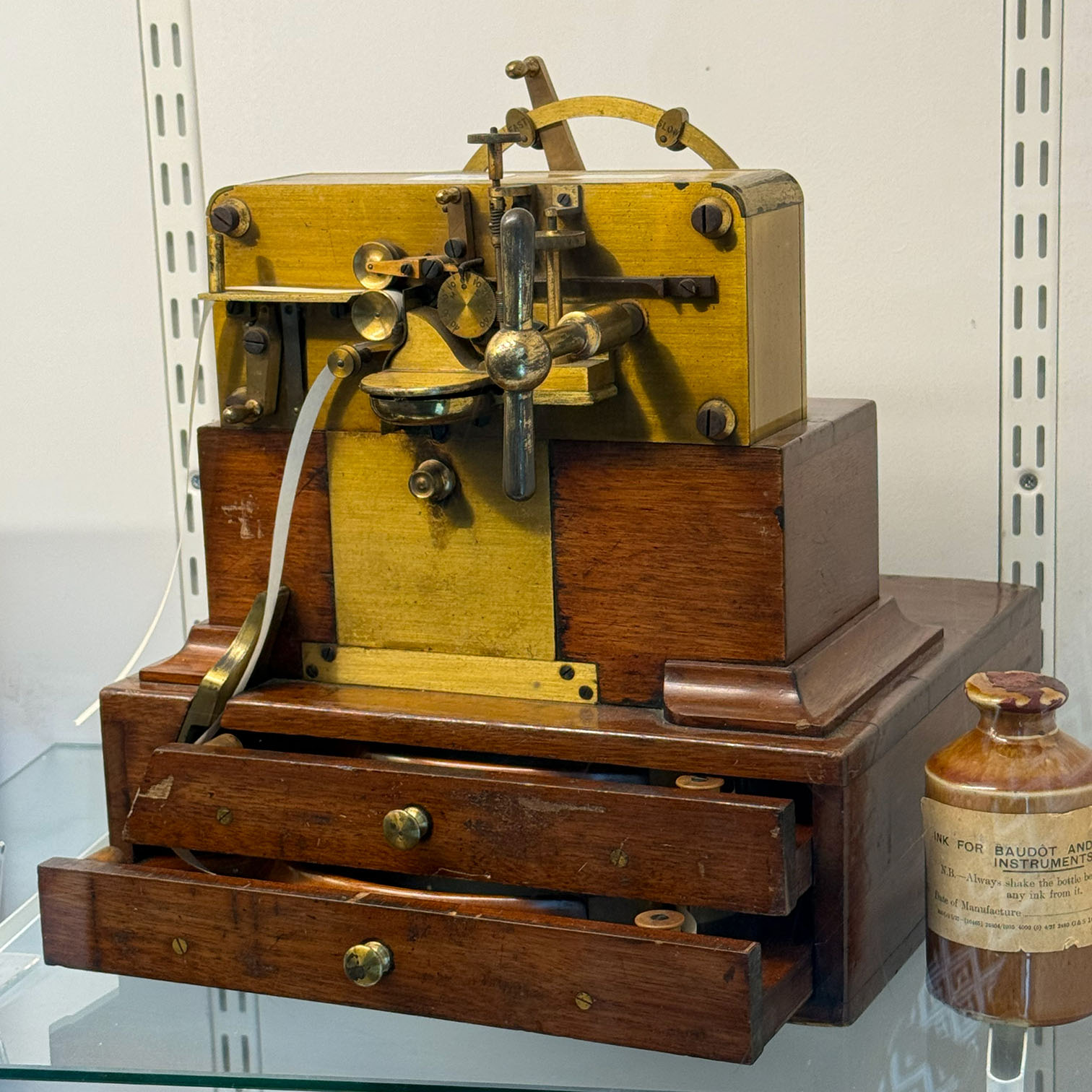 This instrument appears to be a Victorian or Edwardian Morse telegraph recorder, also known as a Morse inker or telegraph register. These machines were used in telegraph offices during the 19th century to receive messages and record them as dots and dashes on a continuous strip of paper. Before telephones became widespread, telegrams were an important means of long-distance communication.
A Morse recorder worked as follows:
- An electrical signal arrived along the telegraph wire.
- Electromagnets operated a small mechanical arm.
- A clockwork mechanism pulled a narrow paper tape through the machine.
- An inked wheel or stylus marked dots and dashes onto the moving paper.
- A telegraph operator read the recorded Morse code and translated it into a written message.
Several features suggest a telegraph recording instrument:
- Brass mechanism: Contains the clockwork drive and recording apparatus.
- Wooden cabinet: Houses the mechanism and provides storage.
- Two drawers: Likely used for the paper tape supply and accessories.
- Paper strip on the left: Appears to be the recording tape.
- Small bottle: Possibly contains recording ink, but this is not certain.
It’s probably late 19th or early 20th century. British manufacturers of similar equipment included Siemens Brothers, Elliott Brothers and, later, Marconi.
The Double Plate Sounder with Relay
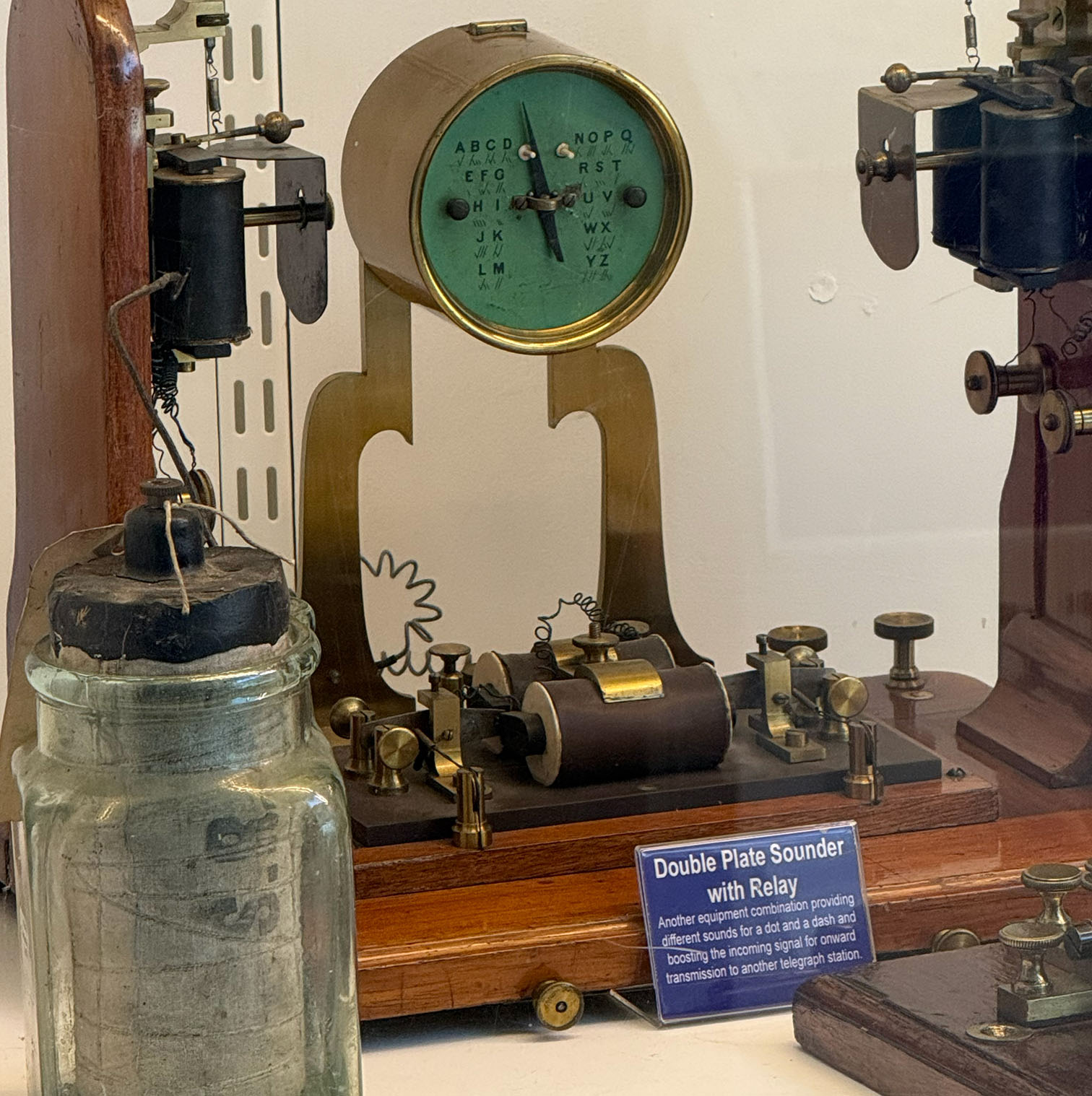 The instrument in this photograph is a fascinating example of early British electric telegraph technology. It is a Double Plate Sounder with Relay, a device used to receive telegraph messages by producing two distinct sounds, one representing a dot and the other a dash.
These instruments were particularly associated with the British railway telegraph system and the General Post Office (GPO) during the Victorian period.
History and development
The double plate sounder developed from an earlier invention known as Bright's Bells, introduced by British telegraph engineer Sir Charles Tilston Bright in 1855.
Bright's original arrangement employed two bells of different tones. One indicated dots, while the other indicated dashes.
The double plate sounder used a similar principle but substituted metal sounding plates for the bells.
It became a popular form of telegraph receiver during the second half of the nineteenth century, although simpler single sounders gradually replaced it on many Post Office circuits around 1880. Some examples remained in use much later.
How the instrument worked
The instrument used two electromagnets, two striking mechanisms and a sensitive electromagnetic relay.
- Receiving a signal: A telegraph operator at another station operated a transmitting key that sent electrical currents of opposite polarity along the telegraph wire.
- Operating the relay: The incoming current moved the relay armature to one side or the other, depending on its polarity.
- Producing the sound: The relay completed a local battery circuit, energising one of the two sounder electromagnets.
- Reading the message: Each electromagnet operated a striker against a metal plate. The two plates produced different notes, allowing the receiving operator to distinguish dots from dashes by ear.
Unlike an ordinary Morse sounder, where dots and dashes were distinguished by the duration between clicks, this instrument gave each signal its own characteristic sound.
The National Telephone Company Limited (1881–1911)
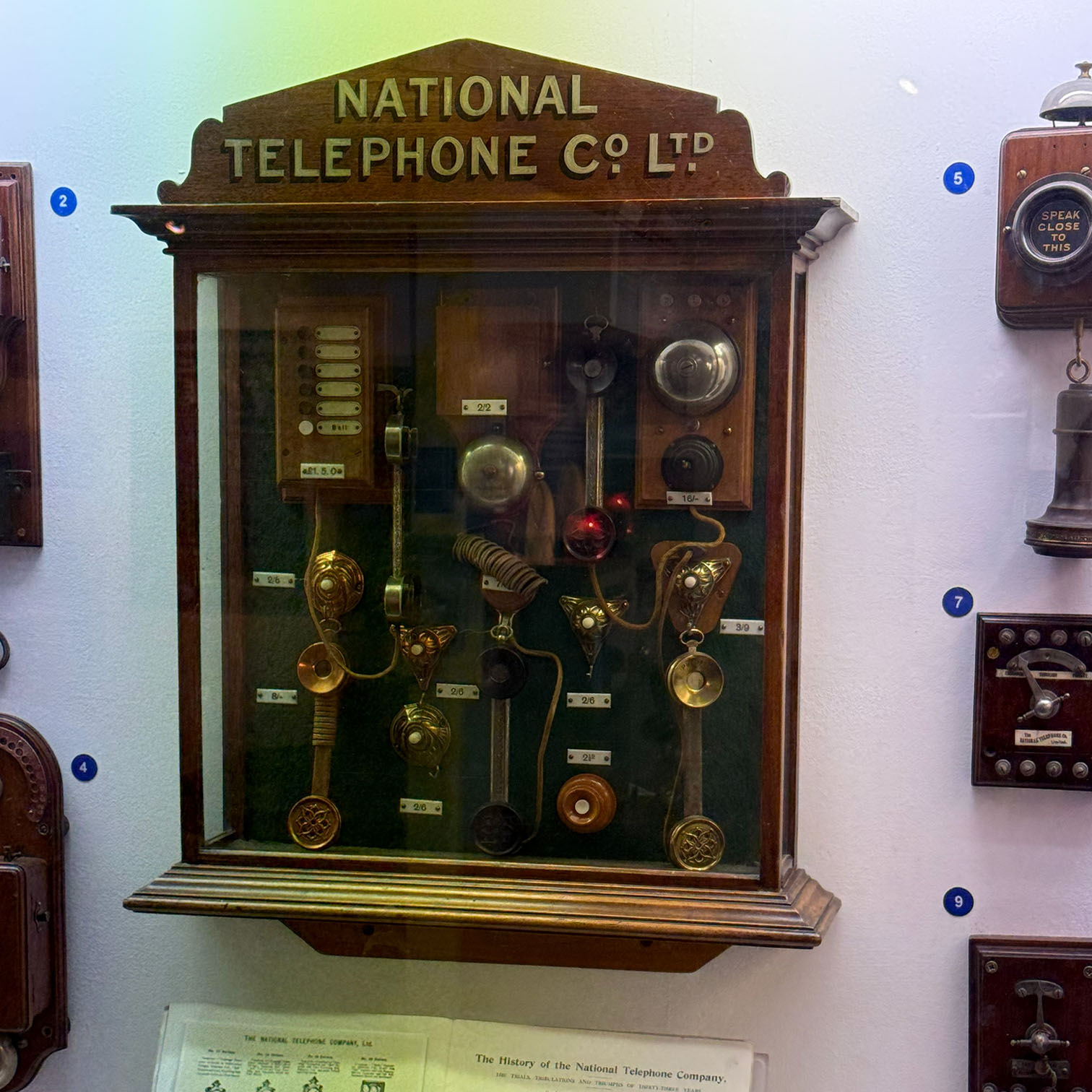 This photo shows some of the equipment used by The National Telephone Company Limited (NTC). It was one of the most important companies in the early history of British telecommunications. Established in 1881, it became the largest private telephone operator in Britain before its network was taken over by the General Post Office (GPO) in 1912.
For approximately 30 years, the company played a major role in introducing telephone exchanges, telephone lines and telephone instruments throughout Britain.
The National Telephone Company was formed on 10 March 1881 as a subsidiary of the United Telephone Company (UTC). The United Telephone Company had been established in 1880 following the amalgamation of two pioneering businesses:
- The Telephone Company (Bell's Patents) Limited.
- The Edison Telephone Company of London Limited.
These businesses controlled important telephone patents associated with Alexander Graham Bell and Thomas Edison. Initially, the National Telephone Company operated in parts of Scotland, Yorkshire, Nottinghamshire and Ireland.
By 1889, the NTC had absorbed its parent company and begun taking over numerous regional telephone companies, eventually becoming Britain's dominant private telephone operator.
During the 1880s and 1890s, the National Telephone Company expanded rapidly.
The company installed telephone exchanges in towns and cities, erected overhead telephone wires, provided telephone instruments to subscribers and employed thousands of engineers, linesmen and exchange operators.
In those days, telephone subscribers generally rented their instruments and connections rather than purchasing the equipment outright. Telephone exchanges were manually operated, with calls connected by operators inserting plugs into switchboards.
Victorian electrical recording apparatus
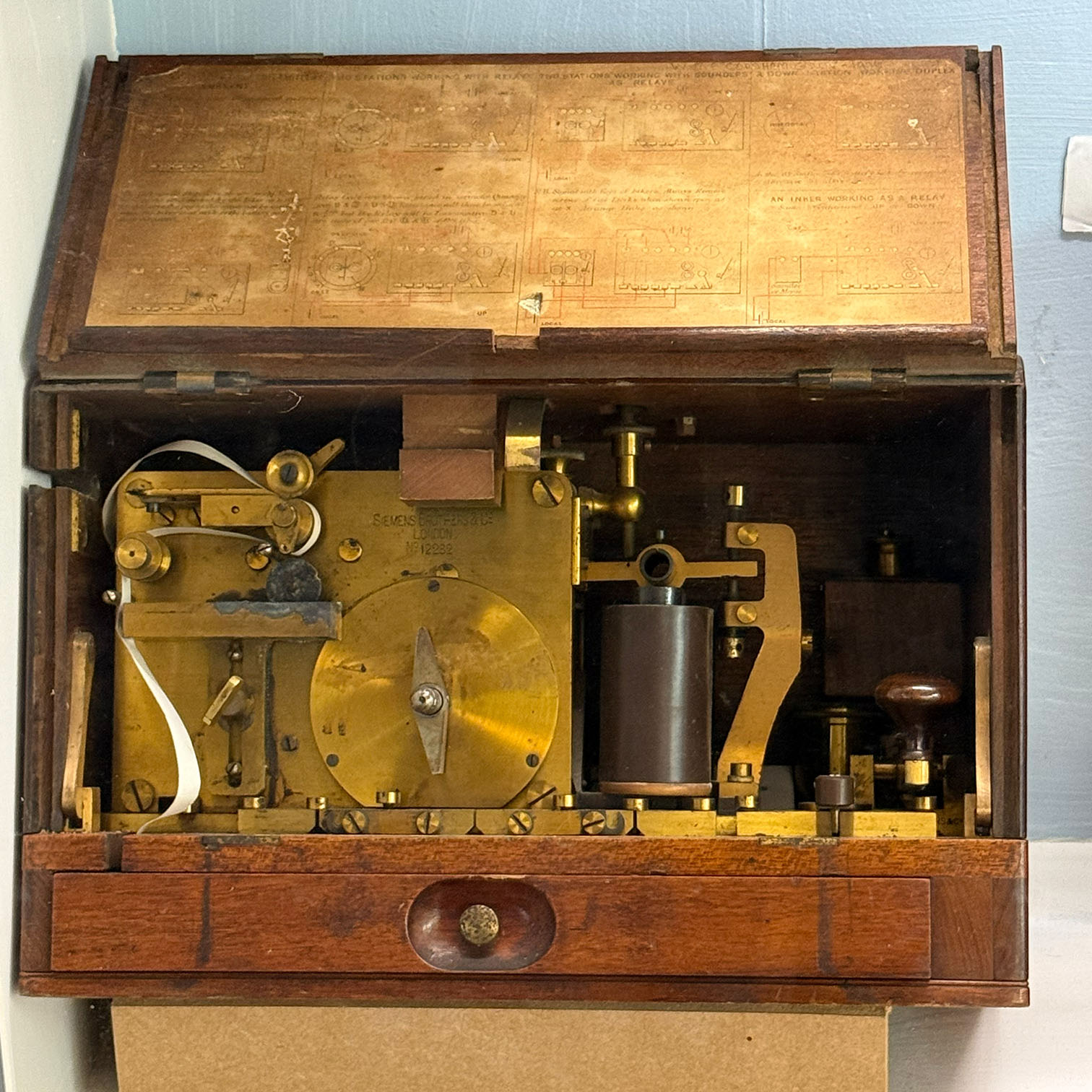 This instrument appears to be a 19th-century electromechanical recording instrument, possibly an early telegraph receiver or register. Further information to follow.
It has a wooden case containing a combination of brass clockwork, mechanical levers and an electromagnet. These are characteristic features of early electrical communication and recording equipment.
- Wooden cabinet: A hinged protective case, typical of Victorian scientific and communications equipment.
- Brass clockwork mechanism: The large circular brass component in the centre appears to form part of a mechanical drive or timing arrangement.
- Electromagnet: The cylindrical component on the right appears to be an electrical coil used to operate a mechanical lever.
- Recording mechanism: The assembly on the left includes what appears to be a narrow strip of paper, suggesting that the instrument may have recorded electrical signals.
- Adjustment controls: Small screws and levers would have allowed an operator to adjust the mechanism.
The mechanism closely resembles a Morse inker, a machine that recorded incoming telegraph messages as dots and dashes on a moving paper strip.
How it worked
- A telegraph operator sent Morse-code pulses along a wire.
- The pulses energised an electromagnet in the receiving instrument.
- The electromagnet moved a mechanical writing arm.
- Clockwork pulled a narrow strip of paper through the machine.
- The resulting marks recorded the message for an operator to read.
Field Telephone D Mk V
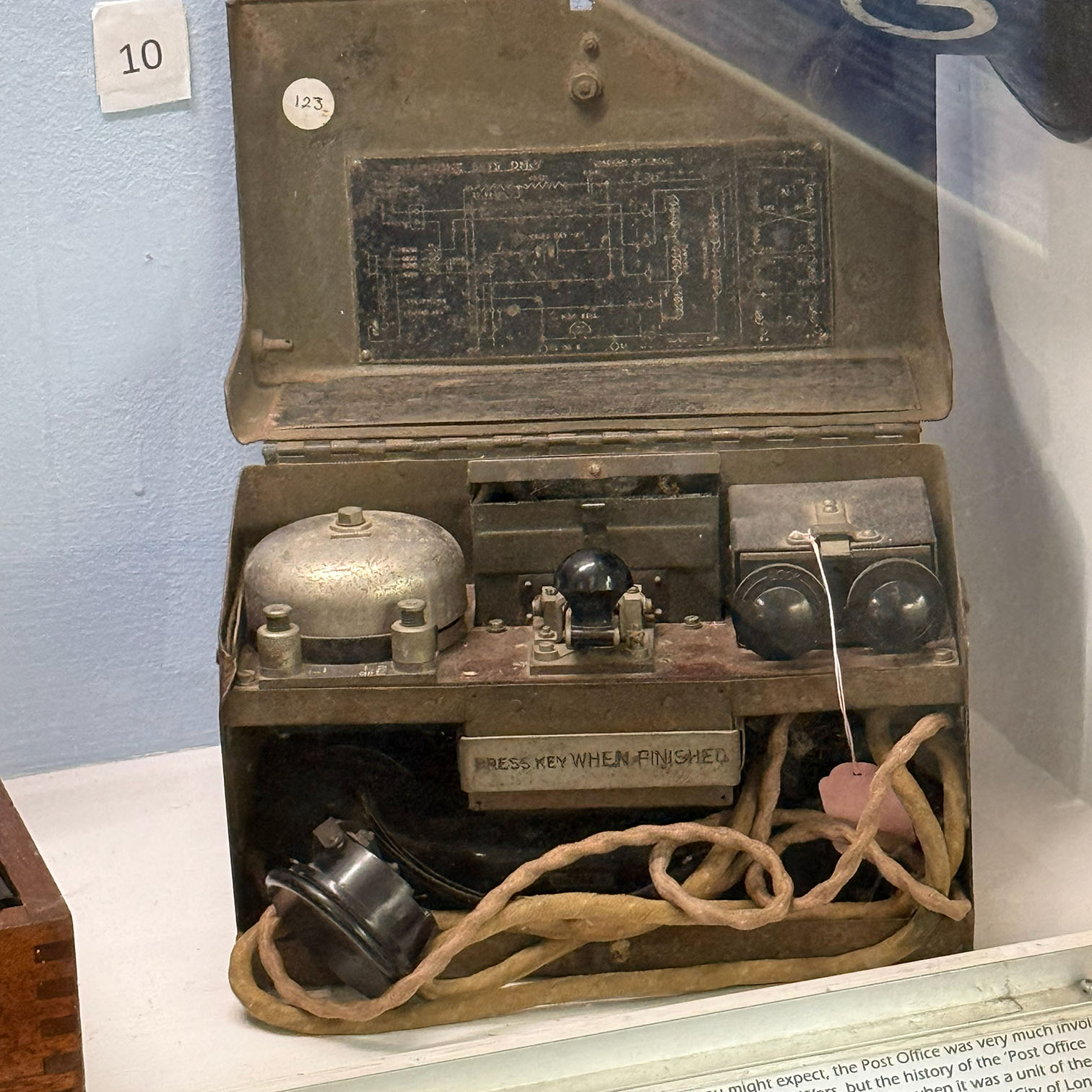 The D Mk V could communicate by ordinary speech or by Morse code over a field telephone cable.
Morse code was especially useful when lines were damaged or conditions made speech difficult to understand. Contemporary accounts describe a speech range of approximately 15 miles and a Morse signalling range of about 25 miles, depending on line conditions.
L.M. Ericsson Skeleton Telephone
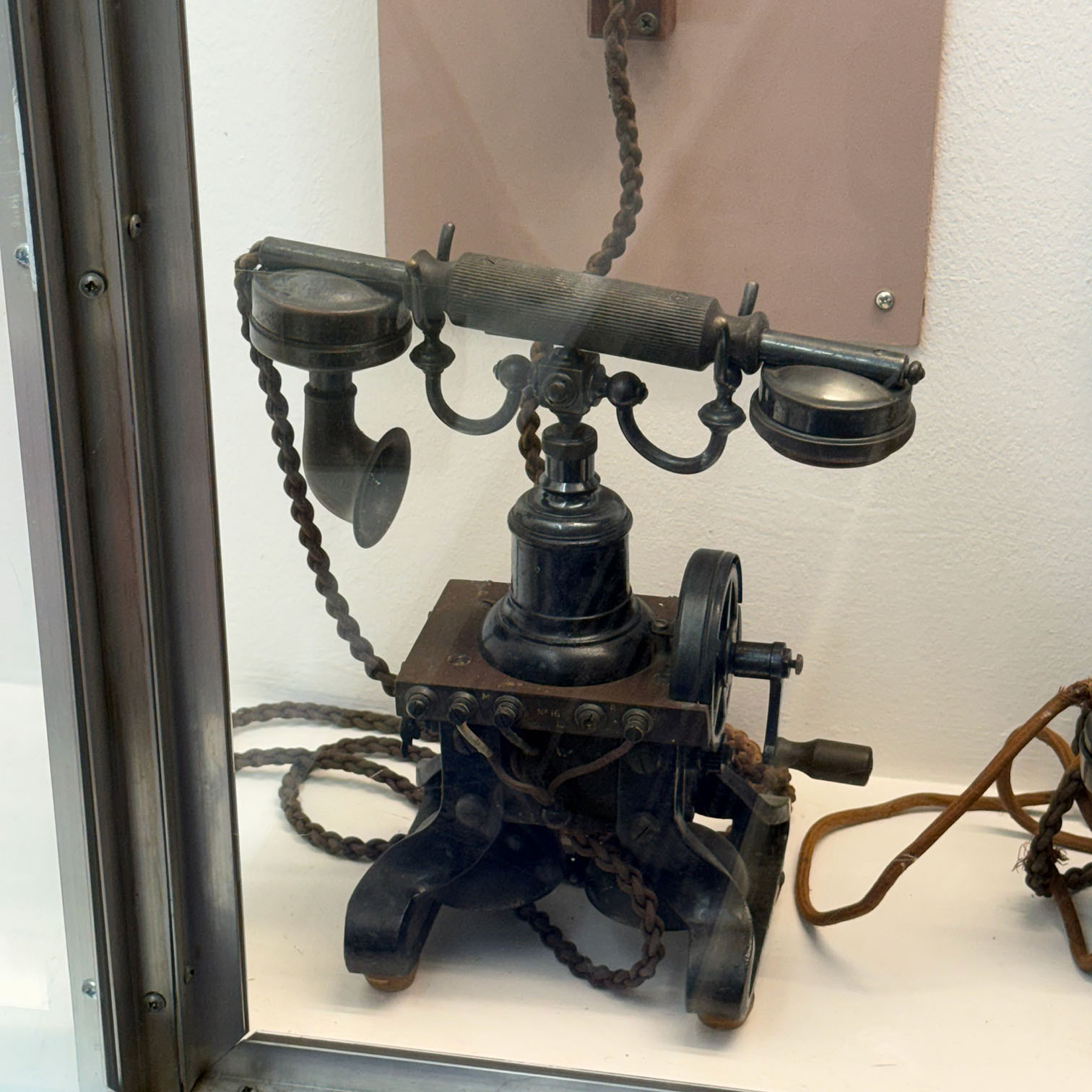 This photograph shows what I believe to be an L.M. Ericsson Skeleton Telephone, also known as the Eiffel Tower Telephone, dating from the late Victorian period. It is one of the most distinctive and historically important early telephone designs.
| Introduced | 1892 |
| Manufacturer | L.M. Ericsson, Sweden |
| Model | Commonly No. 375 / AC |
| Type | Magneto-operated desk telephone |
| Period | 1890s to early 1930s |
- Designed by Lars Magnus Ericsson, the Skeleton Telephone was introduced in 1892, developing an earlier design dating to 1884.
- It was revolutionary because it combined the speaking microphone and listening receiver into a single horizontal handset, rather than using separate instruments.
- The exposed metal construction gave it the name Skeleton Telephone. Its unusual shape also earned it the nicknames Eiffel Tower and Sewing Machine.
- It was widely exported, including to Britain, where Ericsson supplied instruments to the National Telephone Company before the GPO took over the national telephone system in 1912.
Telephone Testing Device
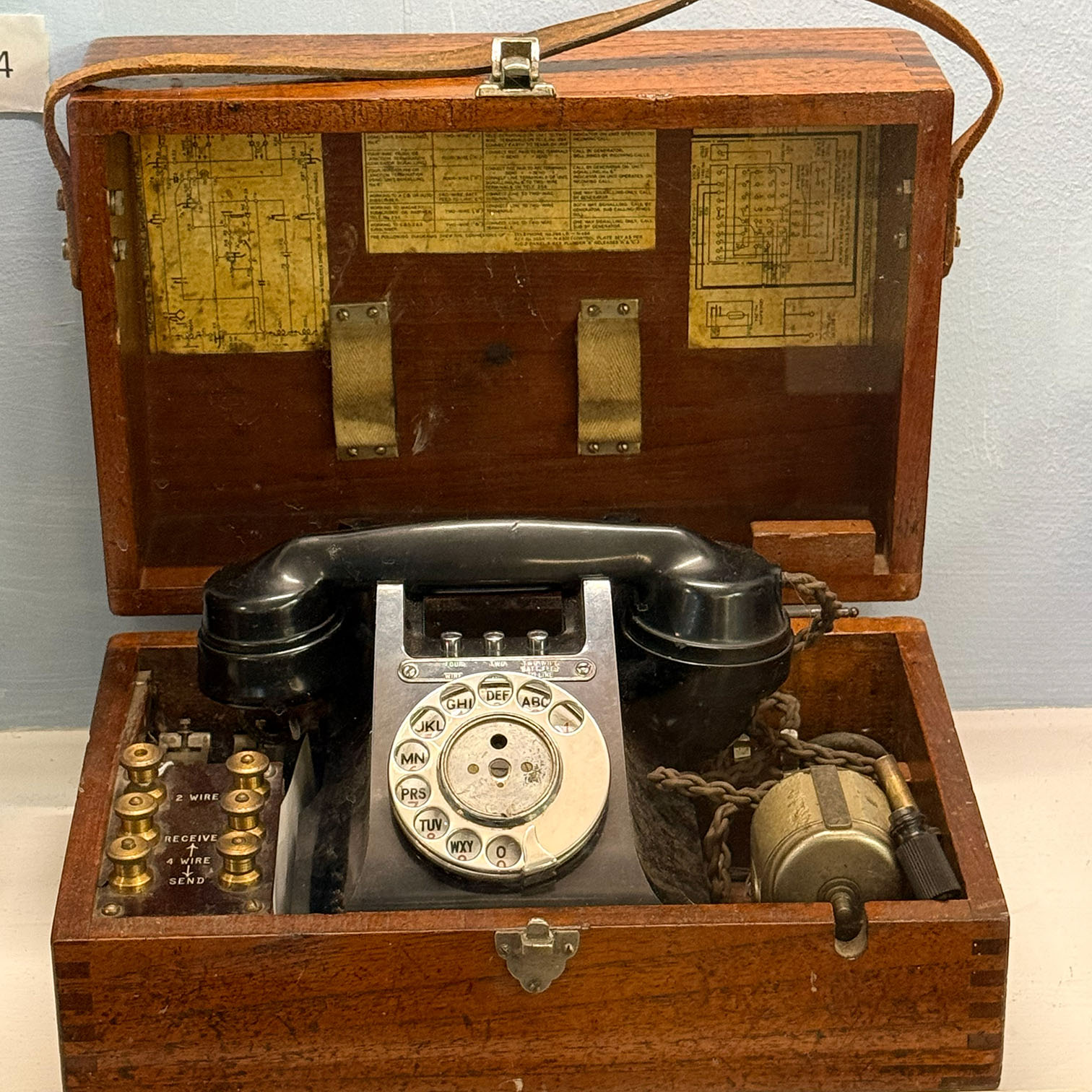 This appears to be a portable telephone testing instrument, rather than an ordinary telephone intended for domestic use. The wooden carrying case contains a rotary-dial telephone handset and several additional electrical components, suggesting it was designed for testing or maintaining telephone circuits.
In the days of the British GPO (General Post Office) telephone service, engineers used portable equipment like this to:
- Test telephone lines for continuity and faults.
- Make test calls from locations where no permanent telephone was installed.
- Check whether a line could receive and transmit speech.
- Test ringing and signalling circuits.
- Help trace faults in telephone exchanges and subscribers' wiring.
The instrument has several characteristics worth noting:
- Rotary dial: Allows an engineer to dial through an automatic telephone exchange.
- Handset: Provides speech communication during testing.
- Electrical components: The additional circuitry may provide line testing and signalling functions.
- Wooden carrying case: Makes the equipment transportable while protecting the instruments.