I bought a B40 communications receiver from GWM Radio, an army surplus store in Worthing. It weighed a ton! Once I’d got it home, I struggled to carry it upstairs to my radio room. Finally managing to install it on my desk, I connected my 150 foot end fed aerial to the receiver. I was amazed when I tuned into an RAF pilot between 4 and 5 MHz. The receiver resolved his SSB signal perfectly.
The trawler band was alive with ships and fishing vessels chatting to coast stations. I tuned in to army manoeuvres on Salisbury Plain. They were using AM around 5.5 MHz. HF broadcast stations from around the world emanated from the speaker. At that time, the B40 was the best receiver I’d owned.
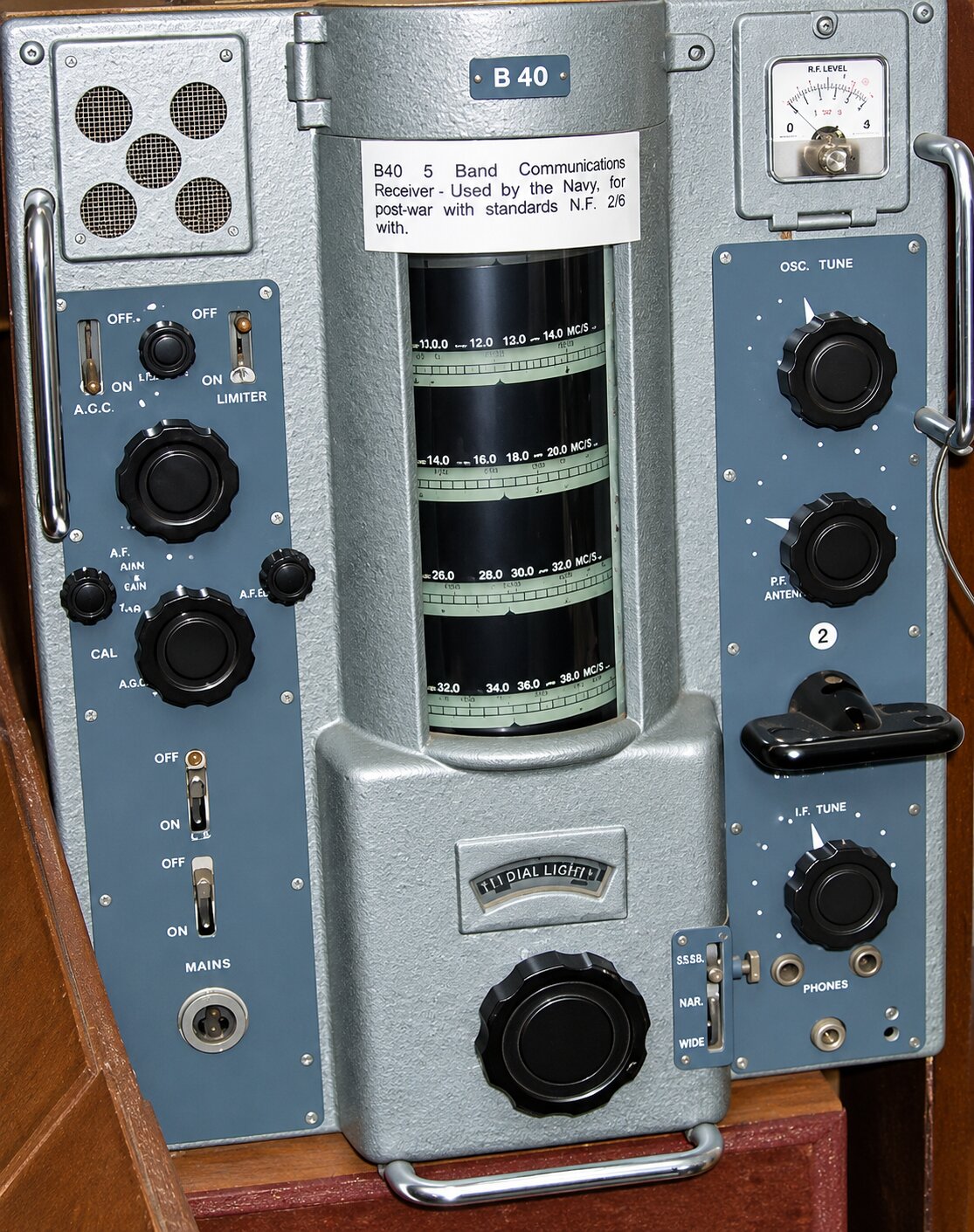 The B40 is a British military communications receiver manufactured by Murphy Radio Ltd during the 1950s. It is a valve receiver designed for reliable communications aboard ships, including use aboard Royal Navy submarines and surface ships.
It is particularly recognisable by its unusual vertical illuminated tuning scale, which has earned it the nickname the Lighthouse Receiver. Production is generally dated to approximately 1953–1956.
The four main versions
There were four principal B40 versions, each incorporating improvements.
- B40A: The original production version.
- B40B: Improvements to the tuning and intermediate-frequency arrangements.
- B40C: Modifications allowing common aerial operation, so several receivers could share an antenna.
- B40D: The most developed version, with oscillator trimming and FSK reception facilities.
The B40D could also be used for SSB reception when fitted with the appropriate FAZ adaptor. It was an important part of post-war Royal Navy communications.
It was used for:
- Receiving naval communications.
- Long-distance HF radio traffic.
- Morse code communications.
- Ship-to-shore communications.
- Submarine wireless communications.
The history of the B40
This radio is an interesting piece of British naval communications history. It belongs to the generation of equipment developed after the Second World War, when the Royal Navy was modernising its radio communications for the Cold War.
Its origins – post-war Britain
Following the Second World War, the Royal Navy needed more modern radio equipment. Wartime receivers had served their purpose, but advances in radio technology meant that newer equipment could offer:
- Better frequency stability.
- Improved sensitivity.
- Greater selectivity.
- More reliable reception over long distances.
- Better reception of Morse and other radio signals.
Life aboard Royal Navy ships
The receiver entered Royal Navy service during the early 1950s and was designed for serious naval communications work rather than domestic listening. It could receive signals across a very wide range of frequencies, making it useful for monitoring different naval communication networks.
Its duties included receiving:
- Naval operational messages.
- Morse code traffic.
- Shore station transmissions.
- International HF communications.
- Communications from other ships and shore establishments.
It was particularly suited to the demanding environment of naval radio rooms.
The B40 was designed in 1946
One particularly interesting historical detail is that the B40's design dates back to 1946, shortly after the war. It was intended to replace the earlier Admiralty B28 receiver.
The B40 subsequently appeared in several versions, with production and service extending into the following decade. The different versions reflect the development of naval radio requirements.
The B40D was capable of frequency-shift keying (FSK) reception. Later, the FAZ adaptor allowed suitable B40 receivers to receive single-sideband transmissions. During the 1950s, naval communications became increasingly important as Britain entered the Cold War.
Ships needed to maintain contact with:
- Royal Navy shore stations.
- Other naval vessels.
- Overseas naval establishments.
- Command headquarters.
The B40 was also used by the Royal Australian Navy, demonstrating that its usefulness extended beyond Britain.