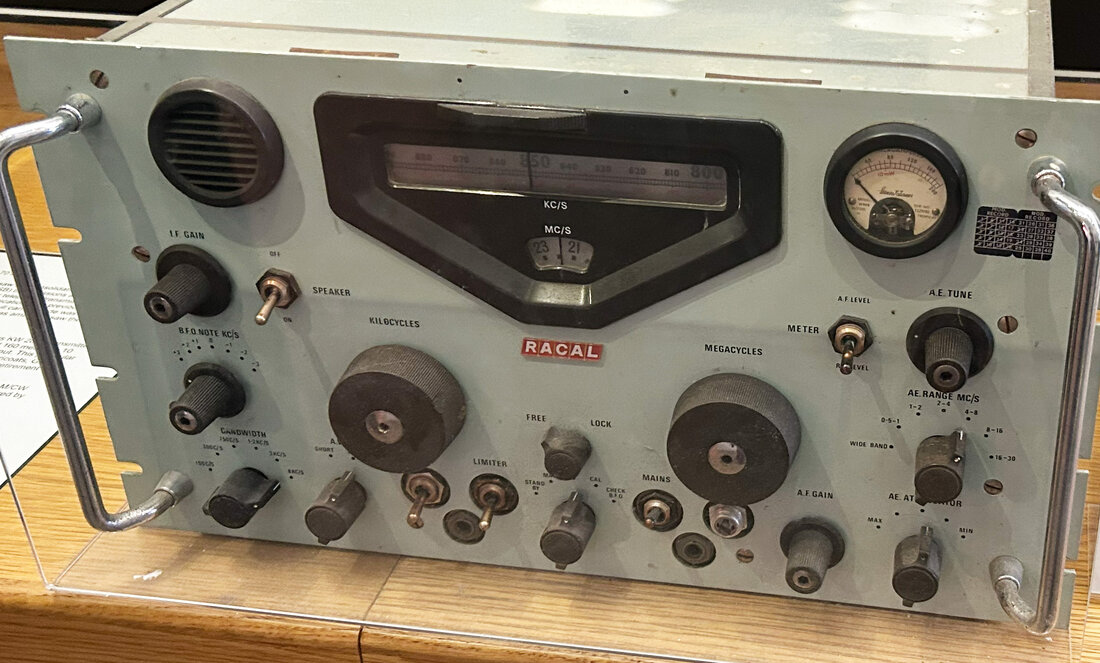
 The Racal RA17 is one of the most famous British communications receivers ever produced. Introduced in the 1950s, it became highly regarded by amateur radio operators, government organisations, military services and radio monitoring stations around the world.
It is particularly well known for its unusual frequency-conversion system, excellent stability and ability to receive very weak signals.
It is also a fascinating example of British valve-era radio engineering.
History and development
The RA17 was developed by the British company Racal during the early 1950s.
Racal was founded in 1950 by former Royal Navy radar specialists. The company's engineers developed a receiver that offered exceptional performance for its time.
The RA17 entered production in the mid-1950s and was used extensively throughout the Cold War.
Its users included:
- British military and government communications organisations.
- Diplomatic and intelligence monitoring stations.
- Amateur radio enthusiasts.
- Commercial radio monitoring services.
- Overseas military and government operators.
The receiver became particularly famous for its use of the Wadley Loop frequency-stabilisation system.
Specifications
| Specification | Details |
|---|---|
| Manufacturer | Racal |
| Model | RA17 |
| Introduction | Mid-1950s |
| Receiver type | Superheterodyne |
| Technology | Thermionic valves |
| Frequency coverage | 500 kHz–30 MHz |
| Tuning | Main tuning and megacycle scale |
| Detection | AM, CW and SSB |
| Frequency stability | Excellent for its era |
| Power supply | Mains-powered, depending on version |
The famous Wadley Loop
One of the most interesting features of the RA17 is its use of the Wadley Loop, developed by South African engineer Dr Trevor Wadley. Traditional valve receivers could suffer from oscillator drift, particularly as they warmed up. The Wadley Loop overcame much of this problem by using a frequency-comparison and mixing arrangement that effectively cancelled much of the local oscillator drift.
The result was a receiver with remarkably good frequency stability without requiring the complicated crystal-controlled synthesiser systems that came later. This was a major engineering achievement and one of the reasons the RA17 gained such a strong reputation.
Versions of the RA17
There are several versions worth knowing about:
| Version | Description |
|---|---|
| RA17 Mk I | Original production version |
| RA17 Mk II | Improved production design |
| RA17L | Later and widely encountered version |
| RA17L Mk III | Later development with circuit refinements |
There were also associated receivers and accessories, including the RA37 LF converter and RA137 SSB/ISB adapter.