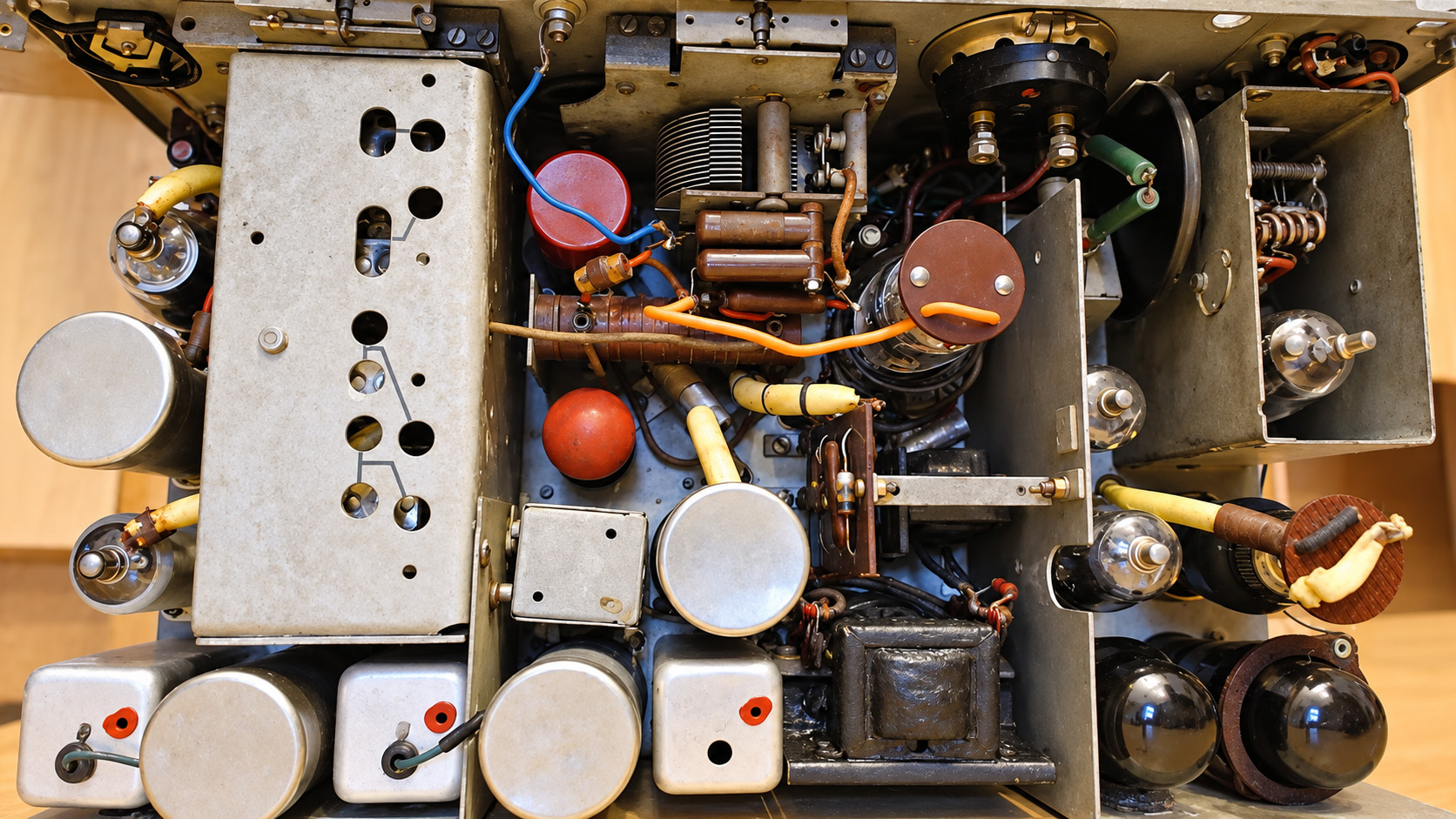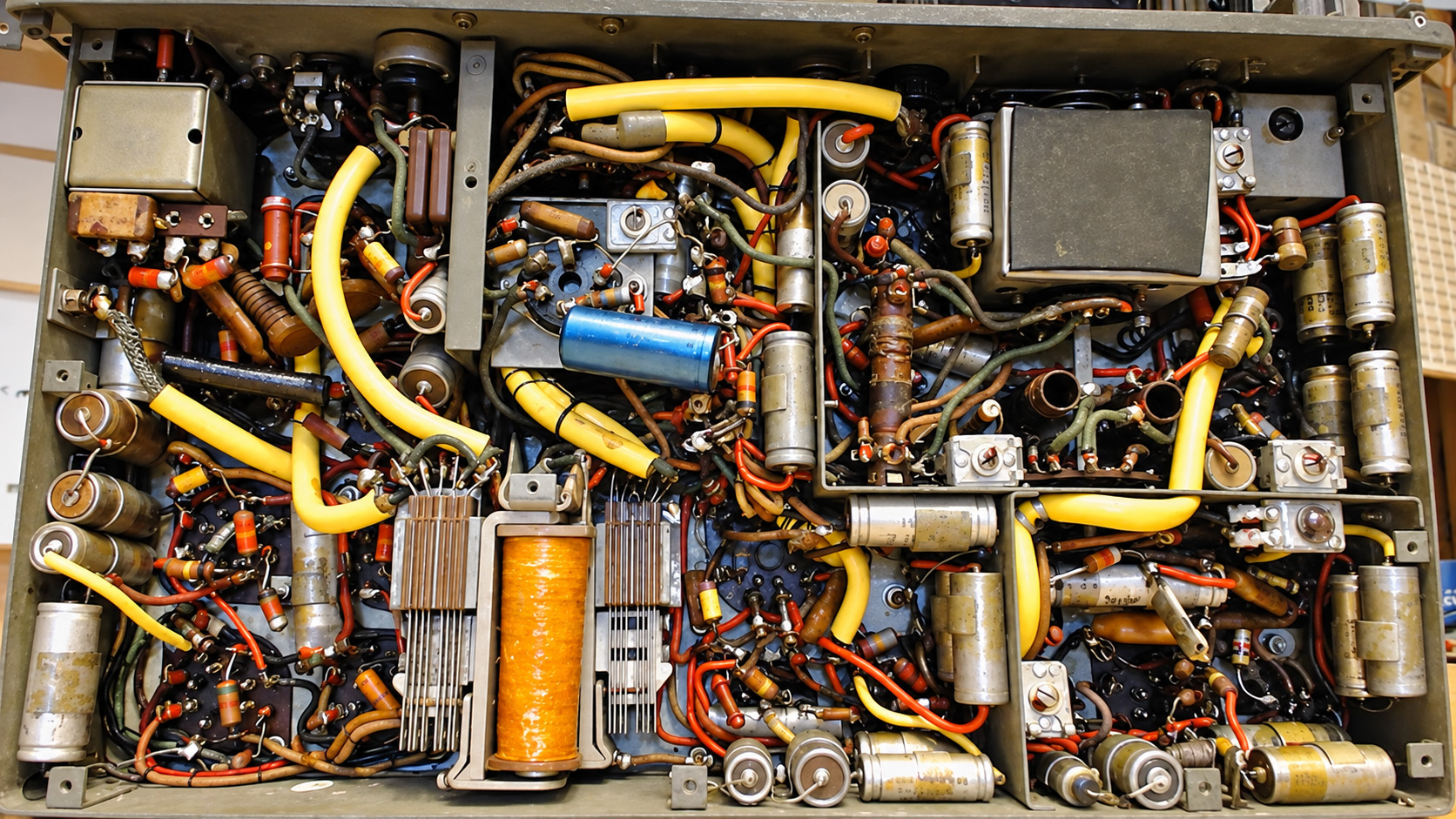
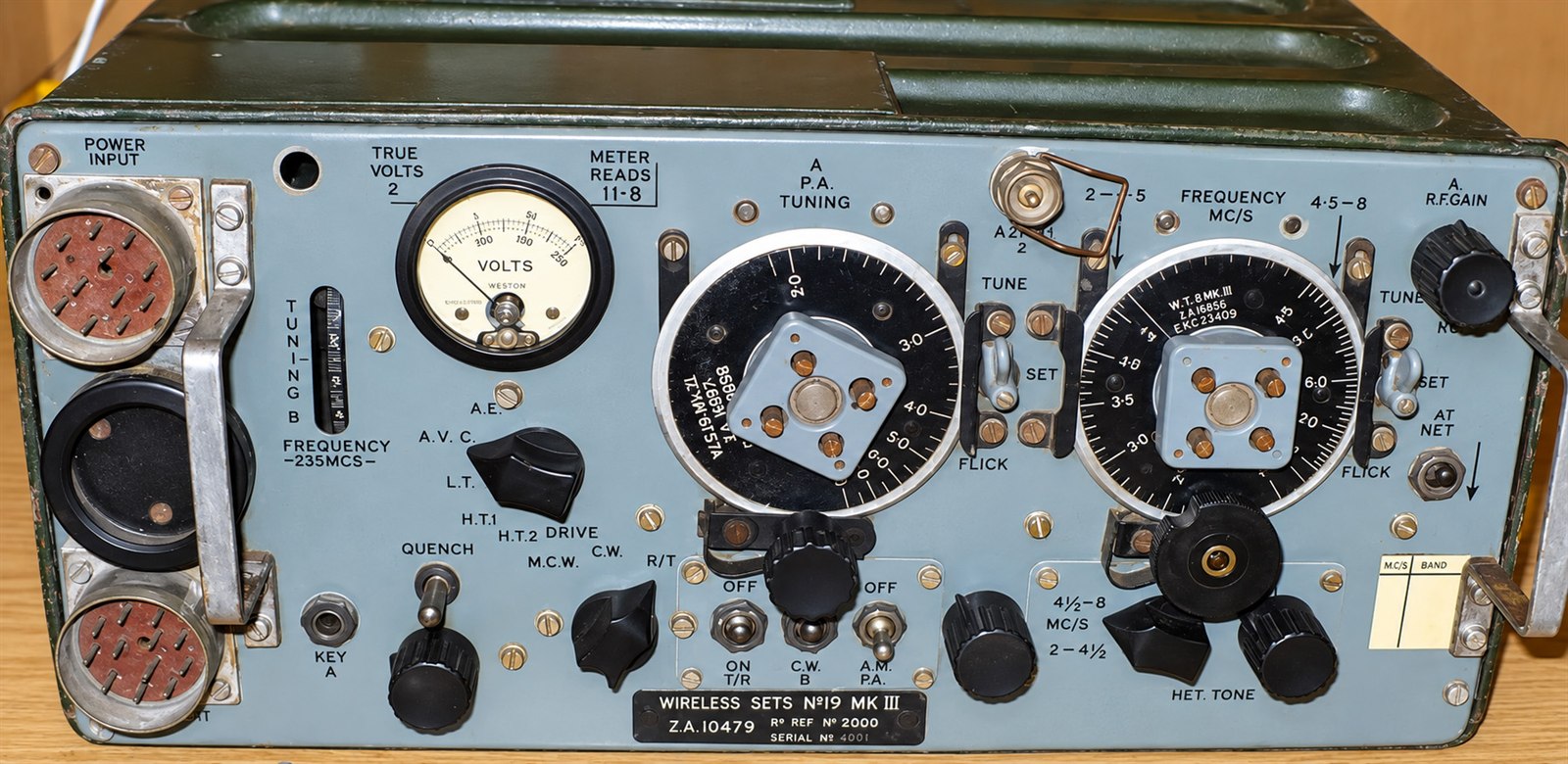
The Wireless Set No. 19, commonly called the 19 Set, was one of the most important British military radio sets of the Second World War. Developed by Pye in Cambridge in 1940, it was designed primarily for use in tanks and other armoured fighting vehicles.
It was a remarkably versatile piece of equipment, combining two independent radio transmitter-receivers and a crew intercommunication system in one unit.
It remained in military service well into the 1950s and subsequently became extremely popular with radio amateurs, particularly in Britain.
Three communication systems in one.
The No. 19 was unusual because it incorporated three separate communication facilities.
The A Set – Main HF transmitter and receiver.
This was the principal radio used for communication between tanks, command vehicles and headquarters.
- Frequency coverage: 2–8 MHz on the Mk II and Mk III.
- Modes: AM speech, CW and MCW.
- RF output: approximately 2.5–9 watts, depending on mode.
- Typical working range: approximately 10 miles, although conditions and aerial arrangements made a considerable difference.
The B Set – Short-range VHF transmitter and receiver.
This operated between 229 and 241 MHz and was intended for communication between tanks operating close together. Its typical range was around 1,000 yards. In practice, it was not particularly successful, and many later sets had the B section disabled or removed
The Intercommunication System:
The third section was an audio intercom amplifier, allowing the tank commander, driver and other crew members to communicate using headsets and microphones. This was essential inside noisy armoured vehicles.
Technical Specifications:
- Manufacturer: Pye and other British, Canadian and American manufacturers
- Introduced: 1940
- Main HF coverage: 2–8 MHz (Mk II and III)
- VHF coverage: 229–241 MHz
- Modulation: AM, CW, MCW
- Transmitter output: Approximately 2.5–9 W
- Receiver: Superheterodyne
- Valves: Approximately 15, depending on version
- Power supply: External rotary generator supply
- Complete weight: Approximately 40 kg
- Main application: Tank and armoured vehicle communications
Mk I – 1940
The original version covered approximately 2.5–6.25 MHz on a single tuning range. It was difficult to tune accurately, particularly under battlefield conditions.
Mk II – 1941
Introduced improved tuning with two HF frequency ranges. This became a very widely manufactured version.
Further improvements included a revised front panel and tuning arrangements. This is one of the versions most commonly encountered by collectors.
An interesting feature: the Flick mechanism:
One particularly clever feature of the 19 Set was the mechanical Flick tuning system. The operator could preset two frequencies and change rapidly between them using a special switch and mechanical tuning arrangement. This was especially useful in a moving tank, where it was difficult to retune the radio carefully while travelling over rough ground.
The radio also employed a common tuning system for transmitting and receiving, simplifying operation. The 19 Set used thermionic valves throughout and required several different operating voltages. The equipment was powered from the vehicle electrical system using a separate rotary generator power supply, commonly known as a dynamotor. This converted the vehicle's low-voltage DC supply into the high voltages required by the valves.
The transmitter used the well-known 807 beam power tetrode in its RF output stage. The receiver employed valves including types such as the EF50, which was an important development in British wartime radio engineering. A separate RF amplifier could also be fitted to provide greater transmitter power and increased communication range.
The 19 Set after the war
After the war, enormous quantities of military radio equipment appeared on the surplus market. The Wireless Set No. 19 was particularly attractive to British radio amateurs because it was rugged, relatively inexpensive and already covered useful amateur frequencies.
For example, the A Set could operate on:
- 160 metres: Part of the band, from 2.0 MHz upwards.
- 80 metres: The entire UK amateur allocation around 3.5 MHz.
- 40 metres: The entire UK amateur allocation around 7 MHz.
The receiver and transmitter were not particularly sophisticated by later standards, but the equipment was capable of making good contacts on both AM and CW. Some amateurs modified the sets for improved stability, easier power supplies and increased RF output.
During the 1950s and 1960s, the distinctive sound of the 19 Set could often be heard on the amateur bands. According to Pye's company history, approximately 115,000 Wireless Sets No. 19 were manufactured during the war.
They were produced in Britain, Canada and the United States. Large quantities were supplied to the Soviet Union under Lend-Lease arrangements, which explains why surviving Canadian-built examples often have both English and Cyrillic markings on their front panels.