Radio in Britain During the 1950s – A New Era After the War
The 1950s were a fascinating period in the history of British radio. After the hardship, uncertainty and restrictions of the Second World War, Britain was gradually returning to normal life. Radio, or the wireless as most people called it, was one of the most important sources of news, music and entertainment.
During the war, families had gathered around their wireless sets to hear the latest news from the front, government announcements and speeches from Winston Churchill. The wireless had been a lifeline, keeping people informed and providing reassurance during some of the country's darkest years.
By the 1950s, its role was changing. People still relied on radio for news, but increasingly they turned to it for enjoyment. Comedy shows, music, variety programmes, dramas and children's programmes became part of everyday family life.
From wartime broadcasting to peacetime entertainment
During the war, BBC broadcasting had been reorganised to meet the needs of the nation and the armed forces. The Forces Programme, introduced in 1940, proved popular because it offered a lighter mixture of music, comedy and entertainment.
Following the end of the war in 1945, the BBC reorganised its domestic radio services. By the 1950s, listeners could choose between three main networks.
- The BBC Home Service: News, current affairs, educational programmes, plays, talks, religious broadcasts and regional programmes.
- The BBC Light Programme: Popular music, comedy, variety, serials and general entertainment. For many households, this became the station they listened to most frequently.
- The BBC Third Programme: Introduced in September 1946, it concentrated on classical music, serious drama, literature and intellectual discussion.
This arrangement gave listeners a much greater choice of programmes than they had enjoyed during the wartime years.
The wireless was still the heart of the home
In the early 1950s, television was still beyond the means of many households, and radio continued to occupy a central position in the family sitting room. The wireless might be switched on first thing in the morning and remain playing for much of the day. Housewives listened to music and magazine programmes while carrying out household chores. Older people enjoyed familiar tunes, plays and conversation.
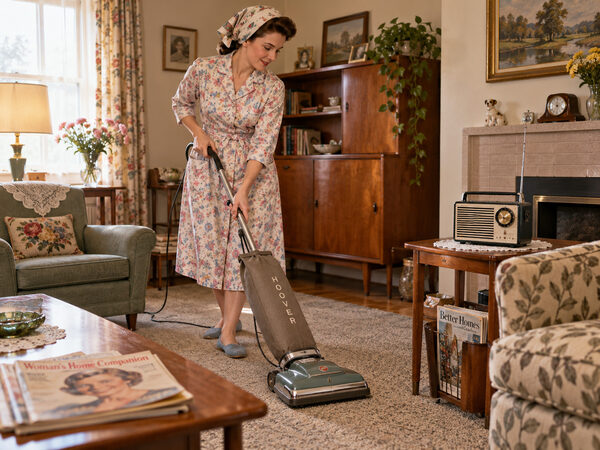 I remember my mother listening to the radio while doing the housework. In later years, when transistor radios came on the scene, she’d carry her Hacker radio from room to room. One of her favourites was Mrs Dale’s Diary. Then there was Jimmy Young. What’s the recipe today, Jim?
In the evening, the family might gather around the wireless set to hear a favourite comedy or variety show. Unlike television, radio allowed people to continue reading, sewing, knitting or doing other jobs while listening. Including housework!
For children, radio could be particularly exciting. Adventure serials, stories and comedy programmes encouraged them to use their imaginations, creating pictures in their minds of the characters and events being described.
The great radio programmes of the 1950s
Some of Britain's most memorable radio programmes either began or enjoyed enormous popularity during this decade.
- The Archers (1951): Everyday life in the fictional village of Ambridge
- The Goon Show (1951): Outrageous and inventive comedy with Spike Milligan, Peter Sellers and Harry Secombe
- Hancock's Half Hour (1954): Comedy featuring Tony Hancock and Sid James
- Family Favourites: Requests and dedications connecting families and servicemen overseas
- Workers' Playtime: Music and variety entertainment, originally introduced during the war
- Listen with Mother (1950): Stories and nursery rhymes for young children
- Mrs Dale's Diary (1948): A popular domestic radio serial
For many listeners, these programmes became fixed appointments in the weekly routine. Families knew when their favourites were due to be broadcast and arranged their activities accordingly. The familiar opening words of Listen with Mother, asking children whether they were sitting comfortably, became part of the childhood memories of an entire generation.
I’ll never forget the Billy Cotton Band Show emanating from the valve radio on Sunday afternoons. In the evening, it was Sing Something Simple. I hated that programme because it reminded me that Monday morning and school was looming.
Popular music and the changing tastes of young people
Music was another area in which radio changed dramatically during the 1950s. In the early part of the decade, dance bands, orchestras and traditional popular songs dominated much of the BBC's lighter output. Performers such as Vera Lynn, Bing Crosby and Frank Sinatra remained familiar favourites.
But by the middle of the decade, a new generation was developing quite different musical tastes. Rock and roll was arriving from America, bringing with it performers such as Bill Haley, Elvis Presley and Little Richard. British performers, including Tommy Steele and later Cliff Richard, helped establish this new style of popular music.
The BBC was initially cautious about rock and roll, and the Light Programme continued to offer a broad mixture of music rather than the continuous pop music familiar today. But the changes were becoming impossible to ignore. Young people increasingly wanted music that was their own, rather than that preferred by their parents. This generation would eventually help transform British radio during the 1960s.
Radio sets became more attractive and modern
The British radio manufacturing industry enjoyed a renewed market for domestic receivers during the post-war years. Manufacturers such as Bush, Ekco, Murphy, Pye, Ferranti, Marconi and HMV produced a wide variety of wireless sets. Designs became more attractive, with polished wooden cabinets, colourful Bakelite cases and, increasingly, moulded plastics.
Most radios still used thermionic valves. The superheterodyne receiver was well established, and the familiar four- or five-valve circuit remained the basis of many domestic sets. Mains-powered receivers were commonplace in homes with electricity, although battery-powered sets continued to be important in rural areas and for portable use. Portable valve radios became more practical, particularly with the development of miniature battery valves and combined HT and LT battery packs.
The introduction of VHF radio
One of the most important technical developments came in 1955, when the BBC began regular VHF/FM broadcasting. The first permanent high-power VHF/FM transmitting station, at Wrotham in Kent, opened on 2 May 1955. It transmitted the BBC's three national services.
Compared with medium-wave AM broadcasting, VHF/FM offered several advantages:
- Better sound quality and frequency response.
- Much less interference from electrical equipment and atmospheric noise.
- Reduced fading under normal reception conditions.
- Improved reproduction of music, particularly on higher-quality receivers.
Radio manufacturers began producing sets fitted with VHF tuning facilities, often covering approximately 88–100 MHz. However, VHF receivers were initially more expensive, and many households continued using medium-wave and long-wave radios for years afterwards.
The first British transistor radios
Another major development arrived in 1956 with the introduction of the British-made Pam 710 transistor radio, designed by Pye. Although early transistor sets were relatively expensive, the advantages were obvious. Transistors required far less power than thermionic valves, produced very little heat and eliminated the need for an HT battery supply.
The Pam 710 originally cost 30 guineas, making it a substantial purchase at the time. Within a few years, smaller and cheaper transistor radios would transform listening habits. Instead of remaining on the sideboard in the sitting room, the wireless could accompany its owner into the garden, on holiday, or to the seaside.
Television begins to challenge radio
Perhaps the greatest change during the 1950s was the rapid growth of television. At the beginning of the decade, relatively few British homes owned television receivers. The BBC records that in 1950 there were approximately 350,000 combined radio and television licences, compared with around 12 million radio-only licences. A major turning point came with the Coronation of Queen Elizabeth II on 2 June 1953.
An estimated 20 million people watched the ceremony on television, many gathering in the homes of friends and neighbours who owned sets. Television ownership increased rapidly afterwards, helped by greater prosperity, more affordable receivers and the introduction of ITV in 1955. By 1957, the number of households with television had overtaken the number relying solely on radio.
Radio was far from finished. People could listen to the wireless while doing other things, something that television could not offer quite so easily.
The end of an era, and the beginning of another
By the end of the 1950s, Britain had changed considerably from the country that emerged from the war in 1945. The days when entire families sat around the wireless every evening were beginning to disappear as television became the main source of home entertainment.
But radio was adapting
VHF broadcasting offered better sound quality, transistor technology was making receivers more portable, and changing musical tastes were creating a demand for new styles of programmes. The foundations were being laid for the broadcasting revolution of the 1960s, when pop music, offshore pirate stations and eventually BBC Radio 1 would transform radio once again.
Pirate radio
Radio Caroline and Radio London, amongst many others, began to dominate the medium wave band. I remember teenagers’ comments… BBC Radio 1 played Beatles songs. But they were performed by the Northern Dance Orchestra! The pirate stations were a massive part of the 1960s. Just about every teenager had a transistor radio in their bedroom. Happy days!
The 1950s were not the end of radio's importance, but the beginning of its transformation. During the war, the wireless had been a vital source of information and reassurance. In the 1950s, it became increasingly associated with music, laughter, companionship and everyday enjoyment.
For millions of British people, the familiar sound of the wireless remained an essential part of daily life, even as the television set gradually took its place in the sitting room.