In the 1960s, record players became an important part of everyday family life. Listening to records was one of the main ways people enjoyed popular music at home. It was the decade when records, hi-fi equipment and portable record players became increasingly popular, particularly in Britain. The arrival of The Beatles, The Rolling Stones and the explosion of pop music made owning a record player almost essential for many young people.
I had my first record player for my twelfth birthday. The trouble was, I didn’t have any records! My parents had given me a couple of 45s. As Long As He Needs Me by Shirley Bassey and another one that I can’t recall. Luckily, a friend down the road had older brothers. They gave me half a dozen records, the best of which was It’s Now Or Never by Elvis Presley. I went to Woolworth’s and, for some unknown reason, bought Little Donkey by Nina & Frederik.
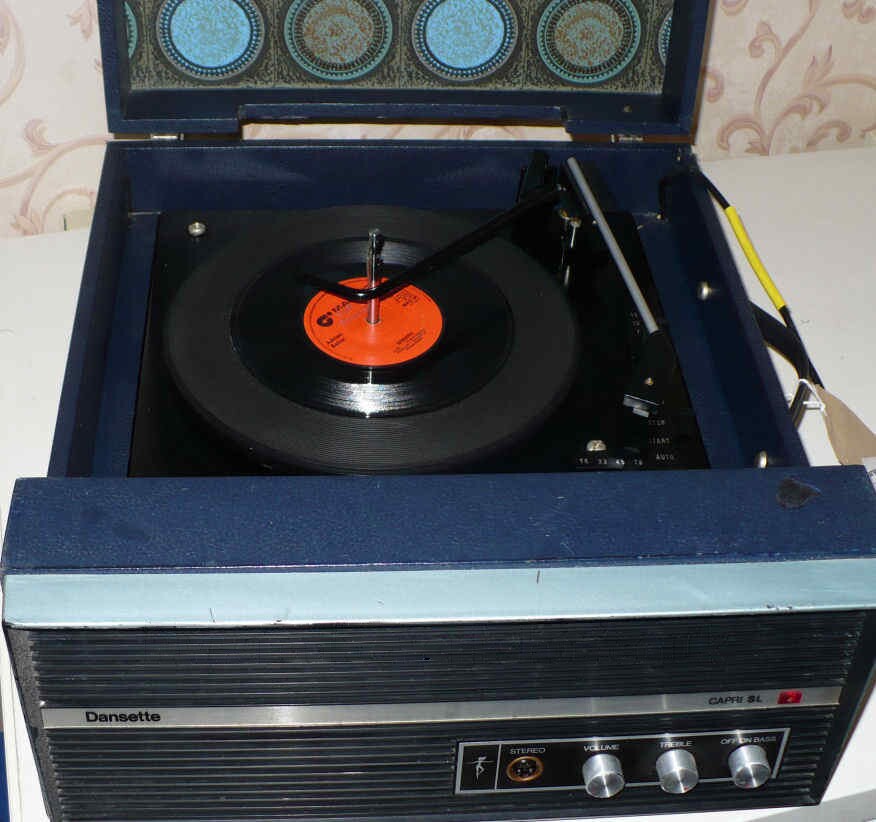
One of the most recognisable record players of the period was the Dansette. Mine was made by Ferranti. These were portable record players, often covered in colourful leatherette, with a handle and metal catches.
Popular features included:
- Built-in loudspeaker.
- Valve or transistor amplifier, depending on the model.
- A hinged lid that protected the turntable.
- Controls for volume and tone.
- A pickup arm with a replaceable stylus.
- Often a four-speed record mechanism.
The different types of records
| Record type | Speed | Typical use |
|---|---|---|
| 78 rpm | 78 | Older shellac records |
| 45 rpm | 45 | Pop singles |
| 33⅓ rpm | 33⅓ | Long-playing albums |
The 7-inch 45 rpm single was particularly important in the 1960s. Young people would buy their favourite songs and build up collections. A 12-inch LP could contain an entire album, usually around 20–25 minutes per side.
The famous record player manufacturers
Dansette was probably the best-known British portable record player. Models such as the Bermuda and Major were popular in homes and teenage bedrooms.
Bush made popular domestic record players, including the SRP series.
Fidelity produced affordable portable record players aimed at the home and teenage market.
Hacker were known for well-built, higher-quality portable audio equipment, including record players.
Many British record players used a turntable mechanism made by BSR (Birmingham Sound Reproducers). These mechanisms were extremely common.
A typical player worked as follows:
- You placed a record on the turntable.
- Selected the speed, usually 33, 45 or 78 rpm.
- Switched on the motor.
- Placed the pickup arm onto the record.
- The stylus followed the grooves, converting their vibrations into an electrical signal.
- An amplifier increased the signal and sent it to the loudspeaker.
Some models had an automatic record changer. You could stack several 45 rpm singles on a central spindle and the machine would drop them one at a time. This was particularly popular with teenagers who wanted to listen to several records without getting up to change them.
Not everybody wanted a portable Dansette. Many households had a radiogram. These were large pieces of furniture combining:
- A radio receiver.
- A record player.
- A built-in amplifier.
- One or more loudspeakers.
They often stood in the living room and were treated as an important piece of household furniture. The 1960s also saw the growth of serious hi-fi equipment. Enthusiasts began buying separate turntables, amplifiers and loudspeakers. Manufacturers such as Garrard, BSR, Goldring and Garrard's competitor, Dual, became familiar names among record enthusiasts.