Military radio transmitters and receivers:
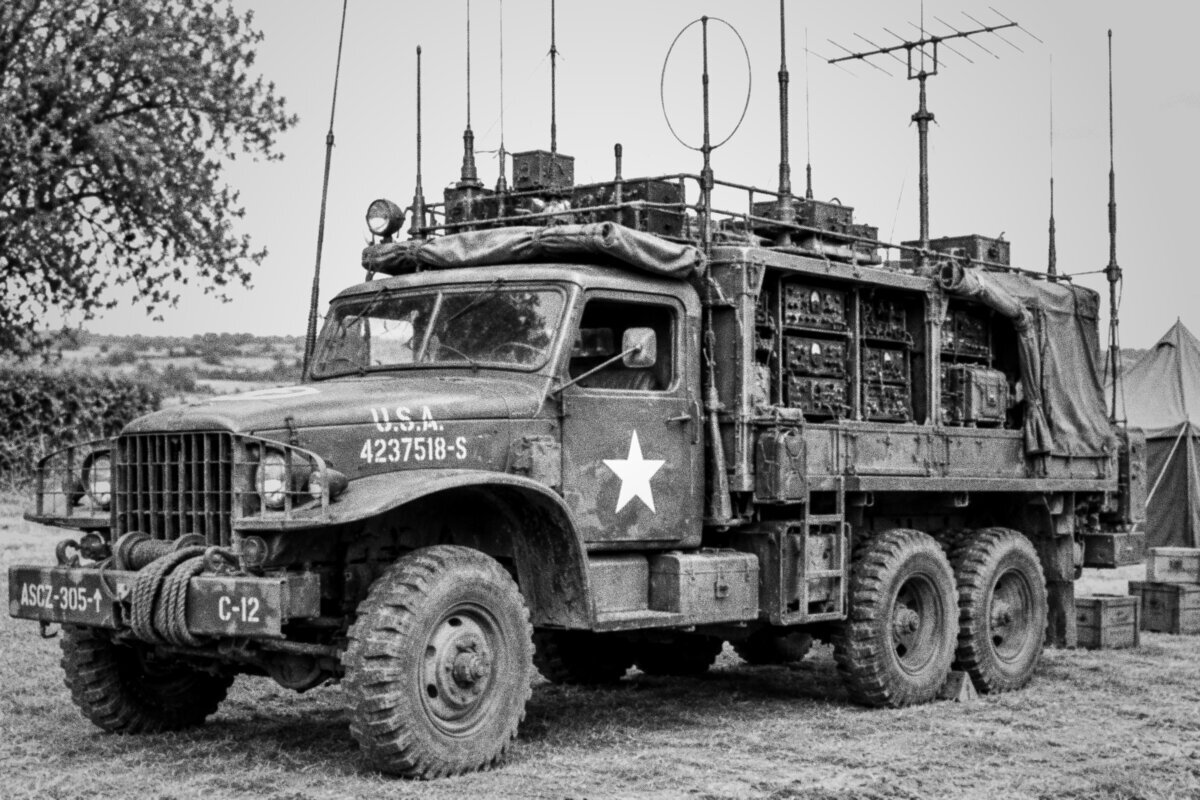 Military radio has been part of my life since my early teens, when I bought army surplus equipment from GWM Radio in Worthing. The 19 Set was my first proper transceiver, and I have owned and used many military sets and communications receivers since.
On these pages I describe the sets I have owned, the ones I still use, and a few I admired but never owned. Pick a heading below, or see the Site Directory for everything on the site.
Second World War wireless sets
The British Army's wartime sets were built to work in tanks, in vehicles and on a soldier's back. Many came onto the surplus market after the war and became popular with radio amateurs.
- Wireless Set No 19. The famous tank set, developed by Pye in 1940. Three communication systems in one unit. Includes a video.
- Another look at the WS 19 set. The 19 Set was my first proper transceiver. I owned several over the years, built power supplies for them and modified them. Includes a video.
- Wireless Set No 18. The infantry set carried on a soldier's back, linking battalion headquarters with companies in the field.
- Wireless Set No 38. A small infantry set from 1942, linking platoons with company headquarters on 7.3 to 9MHz. I owned one in my early teens but never got it working.
- Wireless Set No 22. A low powered set for infantry, artillery and mobile headquarters, covering 2 to 8MHz.
- Wireless Set No 62. Pye's replacement for the 22 set, which served from the end of the war until the late 1960s, including Korea and Malaya.
- Wireless Set No 52. A large Canadian-built station for brigade and division use. I built a 2,500 volt power supply for mine and wish I had never sold it.
- Wireless Set No 12. A transmitter only, normally paired with the R107 receiver, for communications at divisional level.
Post-war military radio
- Wireless Set No 88. The first British VHF-FM manpack set, carried in two webbing pouches. It replaced the 38 set from about 1947. I owned one in the 1960s but never got it working.
- Wireless Set No B44. A Larkspur VHF transceiver from the early 1950s, later adapted by amateurs for the 4 metre band. I owned one and wish I had kept it.
- Pye Wireless Set C12. Introduced in 1955 to replace the 19 set in armoured vehicles. A friend owned one, but I was never lucky enough to.
- Reception Set R209/2/B. My army receiver, a Mullard design made under licence in Belgium, covering 1 to 20MHz. Strangely, it receives FM as well as AM. Includes a video and an audio message.
- Clansman military radio equipment. My RT320, RT349, RT351 and RT352, with masts, a hand generator and many accessories. Includes a video and an audio message.
- Clansman PRC-320 with external ATU. Why I use an external ATU with my end-fed aerial on the 5MHz frequencies. Includes a video.
Military transmitters
- Collins TCS-12 transmitter. An American Second World War US Navy transmitter, made from about 1941 to 1945 and covering 1.5 to 12MHz on AM and CW. A friend lent me his. Includes a video.
- American HF aircraft transmitter CCT-52210. Built for the US Navy Bureau of Ships, with two 1625 valves in the PA, covering 5.3 to 7MHz. Includes audio messages.
Communications receivers
These valve receivers were built to pull in weak and distant signals. Most saw military service, and many found their way onto amateur and listener stations after the war.
- BC-348. An American airborne receiver from the Second World War, covering 200 to 500kHz and 1.5 to 18MHz. Powered by a built-in dynamotor and popular with amateurs after the war.
- Collins Navy TCS-12 receiver. An American Second World War US Navy receiver, Navy type CMX-46159, covering 1.5 to 12MHz in three bands. Used on PT boats, landing craft and shore stations.
- Marconi CR100. I bought my first CR100 from GWM Radio in my early teens. My CR100/2 now has a product detector for SSB. Includes an audio message.
- Marconi CR300. A British marine receiver from the Second World War, covering 15kHz to 25MHz. The CR300/1 was widely used by the Royal Navy.
- Marconi Atalanta. A British valve receiver made from about 1955 to 1967 for ships and shore stations, covering 15kHz to 28MHz with a 100Hz mechanical filter for Morse.
- Marconi R1155 receiver and T-1154 transmitter. The receiver from the Lancaster bomber, with its matching RAF transmitter. I have had several R1155s, but I never really got on with them. Includes a video.
- Murphy B40. A 1950s Royal Navy receiver, nicknamed the Lighthouse Receiver for its vertical illuminated tuning scale. The B40D added FSK reception.
- National HRO 5TA1, 5A1 communications receiver. The mystery of my HRO, a gift from Roy, G4WTV, and my work to find out which model it is. Includes a video.
- RCA AR88D receiver. An American wartime receiver, many of which were sent to the UK and Russia. Mine weighs 98lbs. Includes two videos.
- Eddystone 358X communications receiver. A British wartime receiver with plug-in coil packs for each band. Includes a video.
- Eddystone 910/1. A rare 1960s Eddystone, built mainly for maritime use, with an unusual incremental tuning system. Includes a video.
- Pye PCR receivers. Portable receivers developed from the 19 set, used by the British Army in Europe after D-Day. Includes a video.
- British Reception Set R.107. A British Army receiver from the Second World War covering 1.2 to 17.5MHz in three bands, used with the Wireless Sets No. 12 and No. 33. Mine was built like a tank.
- Racal RA-1772. Covers 15kHz to 30MHz and tunes down to about 12kHz. I think it is the best receiver I have owned. I repaired power supply faults on mine. Includes videos.
- Sailor R105 marine receiver. A receiver taken from a boat, covering long, medium and short wave up to 4.2MHz with push-button crystal channels. Includes a video.
See also: Communications receivers, GWM Radio Worthing, Recollections of GWM Radio and the 1960s, My visit to Bletchley Park and the Manuals and circuits page.
British Army radio timeline
- 1945–1955: Wartime equipment and replacements. WS19, WS22, WS62 and the new C12.
- Late 1950s–1970s: Larkspur. A13, A14, A40, A41, A42, B47, B48, C42 and C45.
- 1976–2000s: Clansman. PRC-320, PRC-349, PRC-350, PRC-351, PRC-352, VRC-321, VRC-322 and VRC-353.
- Early 2000s onwards: Bowman. Digital and encrypted battlefield communications.